Tutorials
Running a retrospective with sticky notes and stamps
Everyone writes before anyone talks, the stamps say what people feel rather than only how many agree, and it ends with three actions that have names on them.
Last updated 29 August 2026
A retrospective is the meeting where a team looks at how the last stretch of work actually went and changes something. Most of them fail in one of two ways, and both are worth naming before the board makes sense.
The first is that whoever speaks first sets the agenda. Somebody says "I think the deploys were the problem" in minute one, and for the next forty minutes everyone is either agreeing with that or arguing with it, including the four people who came in with something else.
The second is the ending. Eleven improvements go on a list, nobody owns any of them, and the next retro opens with the same eleven. A retro that produces a list has not produced anything.
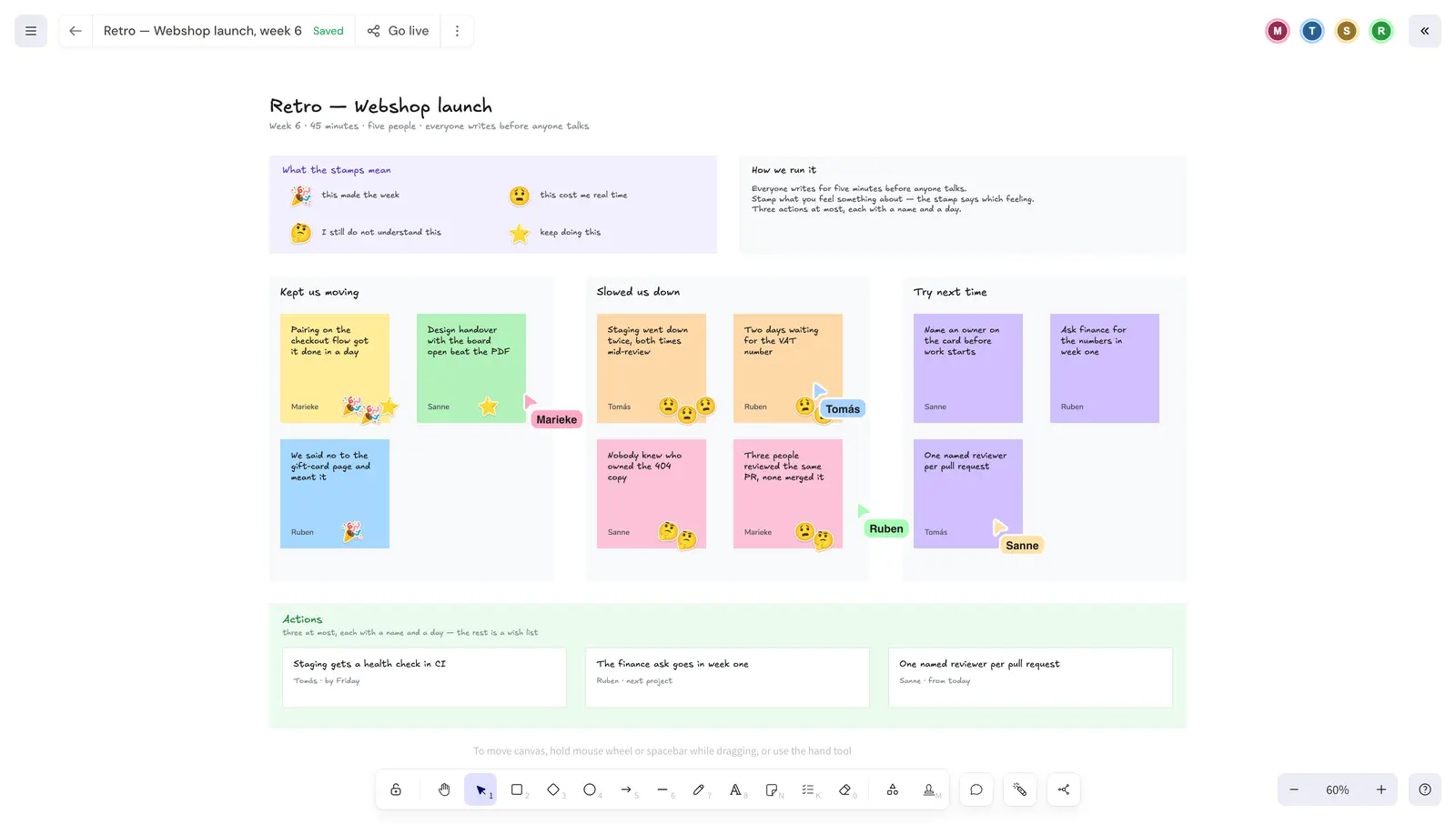
Everyone writes before anyone talks
Five minutes of silence at the start, everyone writing notes at the same time, nobody speaking. This is the fix for the first failure, and it only works if the writing is genuinely simultaneous — which is the thing a shared board gives you and a round of the table cannot.
Press N, click, and type. A note takes the colour you last used, so pick a colour
per column and the board sorts itself visually while people write.
The name at the bottom of each note is not typed by anyone. A sticky note in Kromdraw signs itself with whoever wrote it, which matters more here than it looks: when the discussion gets to a note, you know who to ask about it without anyone having to claim it in front of the group.
Three columns, and none of them is "what went badly"
Kept us moving, Slowed us down, Try next time. The wording is doing real work. "What went well" and "what went badly" invite a verdict on the team, and people are careful when they are being asked for a verdict. "Slowed us down" asks about the work instead, and you get "staging went down twice, both times mid-review" rather than "I think we could communicate better".
Keep the third column open the whole time. Ideas arrive while people are reading each other's notes, and a column to put them in stops the retro turning into a complaint session.
Stamps instead of dot votes
The usual next step is dot voting: everyone gets three dots, sticks them on the notes that matter most, and the counts pick what to discuss. It works, and it throws away the most useful part of what people think.
Three dots on a note tell you three people care. Three weary faces tell you three people care and that the thing cost them time — which is a different note from one with three stars on it, even though the count is identical. So the stamp is the vote, and which stamp you choose is the content.
Agree what they mean first, and put it on the board so nobody has to remember. Press
M to open the stamps.
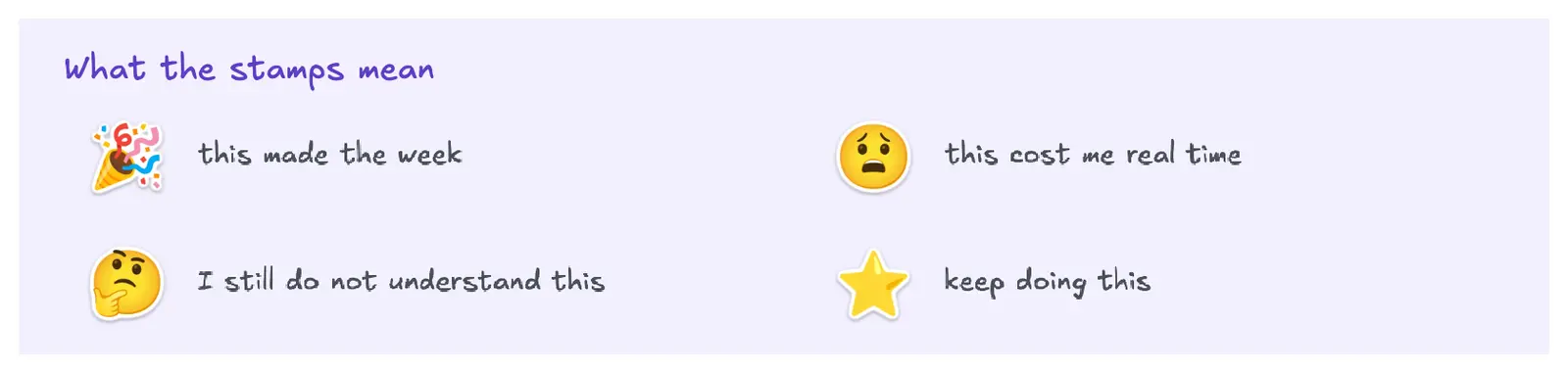
Four is about the limit. The thinking face is the one people underrate: a note nobody understands is not the same as a note nobody cares about, and without a stamp for confusion the two are indistinguishable in the counts.
Reading the board
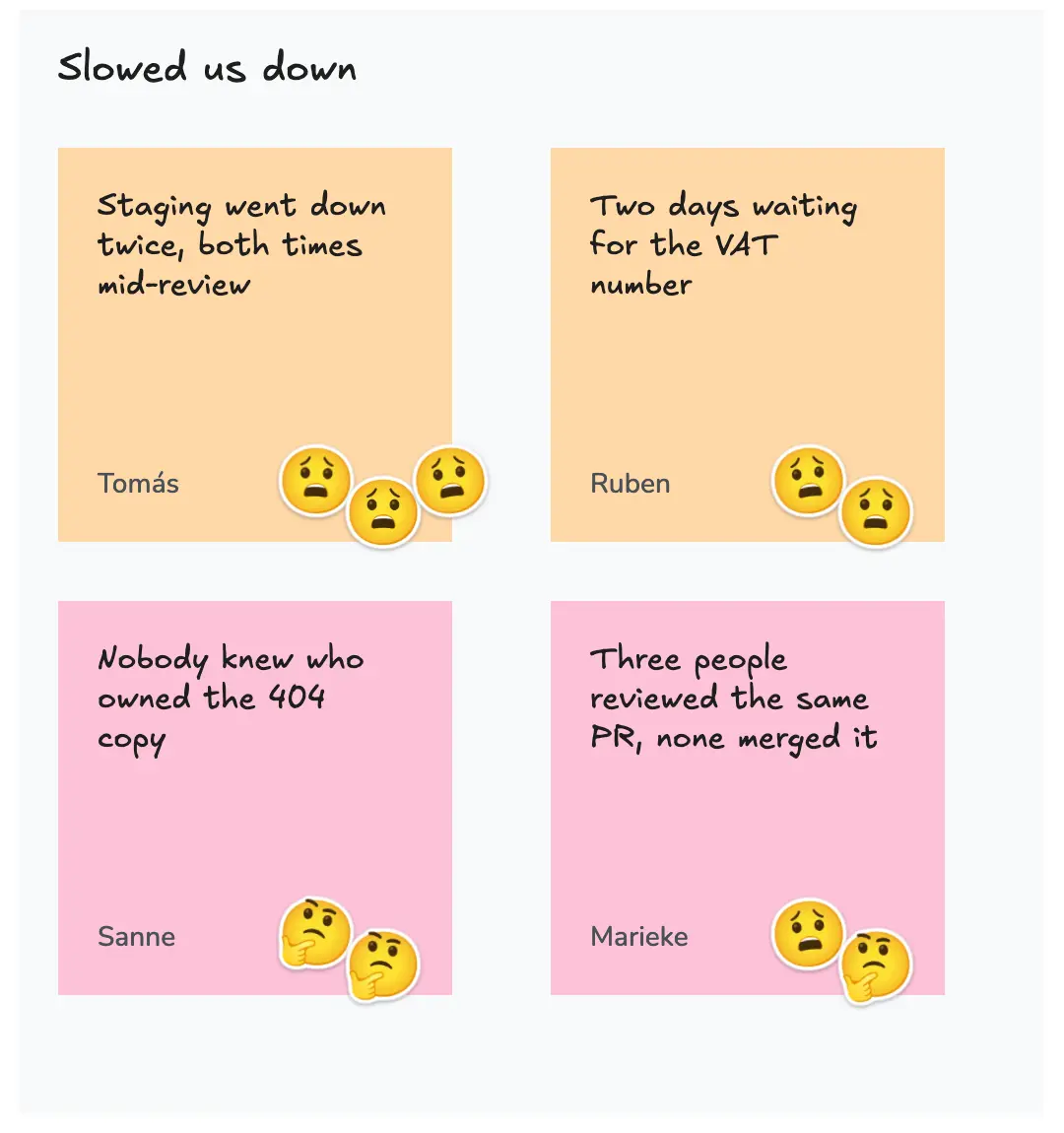
You can read this column without discussing it. Staging is the expensive one — three people lost time to it. The two notes at the bottom carry thinking faces rather than weary ones, which says something specific: nobody is angry about who owned the 404 copy, they are confused about it, and confusion is fixed by writing a name down rather than by changing a process.
Discuss in stamp order, most-stamped first, and stop when the time is up. The notes you never reach are not lost — they are on the board, and they will still be there next week with their stamps on.
Three actions, each with a name and a day

Three is not a target, it is a ceiling. A team that commits to three things does two of them; a team that commits to eleven does none, and arrives at the next retro slightly more cynical than it left this one.
The name is the person who will do it, not the person who raised it — those are often different people, and conflating them is how an action quietly becomes the job of whoever complained. The day is a real day. "Soon" is not a day.
Then leave the board where it is and open it at the start of the next retro. Three actions with dates on them is a two-minute opening item, and it is the only thing that makes the meeting worth repeating.
Why not a form
Anonymous retro forms solve the first failure properly — nobody anchors anybody, and quiet people write as much as loud ones. Two things get lost, and whether that trade is worth it depends on the team.
The grouping goes. Half the value of a retro is noticing that four notes are the same note, and that happens when people physically drag them together, not when a form emails you a list. And the follow-up goes: a form gives you a spreadsheet, and a spreadsheet is not somewhere anyone goes back to.
If your team has a safety problem, use the form. If it has a follow-through problem — which is the far more common one — use the board.
The team, incidents and actions in this example are invented. The method is a practical option for a team to adapt, not an account of how Kromdraw runs retrospectives.
Doing it yourself
Nothing here needs an account. The editor on the front page is the real one.
- Draw three columns and title them after the work, not after the team.
- Agree what four stamps mean and write it on the board before anyone uses one.
- Five minutes of silence. Everyone writes at once with
N. Nobody talks. - Read everything, drag duplicates together, then stamp with
M. - Discuss most-stamped first and stop when time is up.
- Write three actions, each with a name and a day, and open the board again next time.