Tutorials
Planning a bedroom redesign on one board
Inspiration photos, swatches you can hold side by side, the measurements that rule half of it out, and stamps that say what is actually decided.
Last updated 30 August 2026
Everyone plans a room the same way: save forty photographs of rooms, feel good about it, then buy a bed that does not fit. The photographs are not the problem. The problem is that they live somewhere that knows nothing about your room — no wall lengths, no radiator, no door that opens inwards — so nothing ever gets ruled out and every option stays open until the day you have to pay for one.
A board fixes that by holding the pictures and the constraints in the same place, close enough together that you cannot look at one without seeing the other.
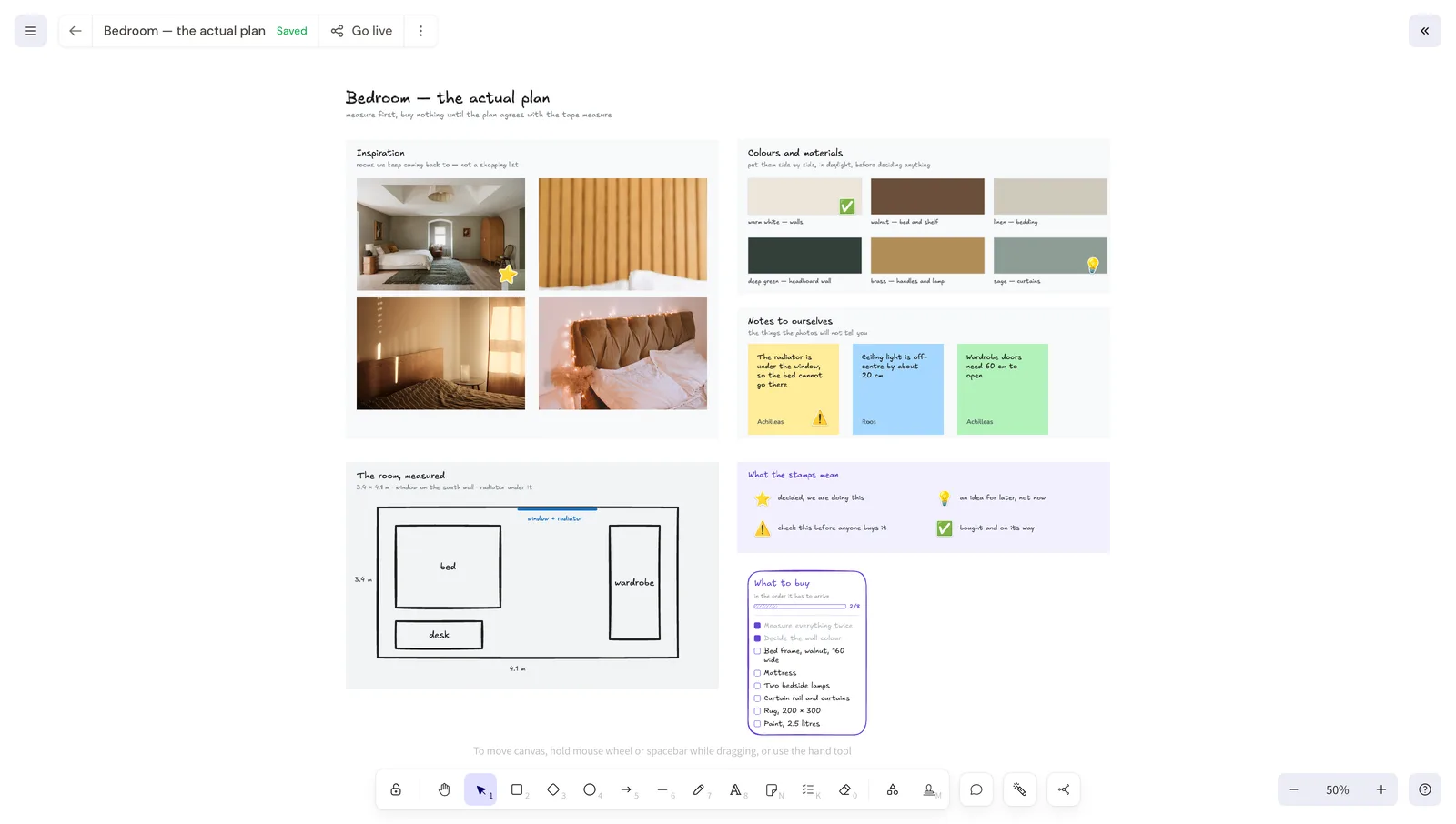
Four photographs, not forty
Paste images straight onto the canvas with Cmd+V, or drag the files
in. Then cut it down. Forty photographs is a mood, and a mood cannot be bought; four is a
decision waiting to happen, because at four you can see what they have in common.
The star is doing real work here. Put one stamp on the single picture you would live in, and everything else on the wall becomes evidence rather than a candidate. It is a much easier question than "which of these forty" and it produces the same answer.
Swatches side by side, in daylight
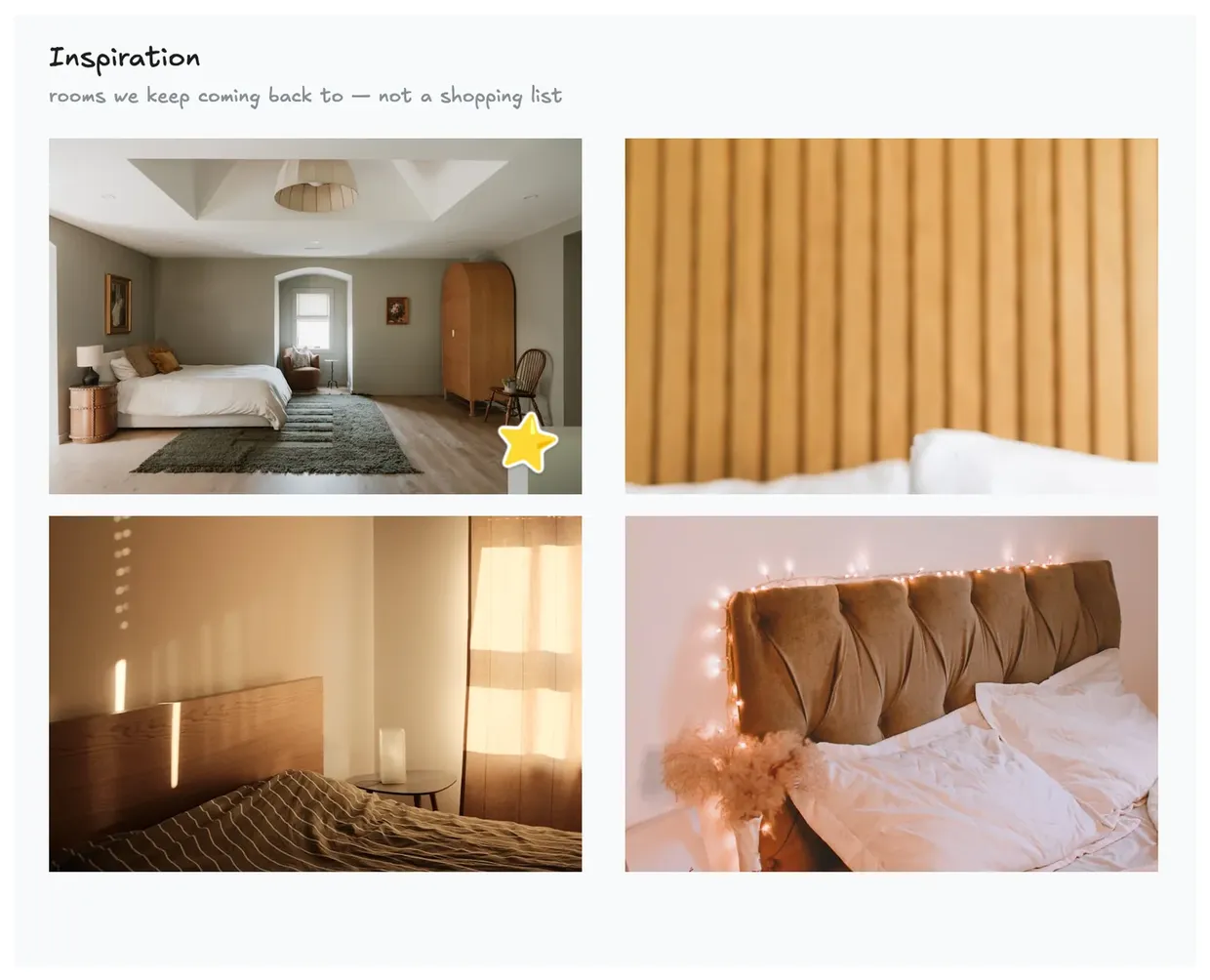
A swatch is a rectangle filled with a colour, which is all a swatch has ever been. The value is not in any one of them, it is in the row: colours are judged against their neighbours, not on their own, and a warm white that looks perfect by itself can look yellow beside a cool linen.
Label each one with what it is for rather than what it is. "Warm white" is a colour. "Warm white — walls" is a decision, and it stops the conversation where two people have quietly been imagining the same colour on different surfaces.
Screens lie about colour, so treat this as the shortlist rather than the choice. It is the row you take to the shop, and the paint chips come back and go next to it.
The room, at its real size
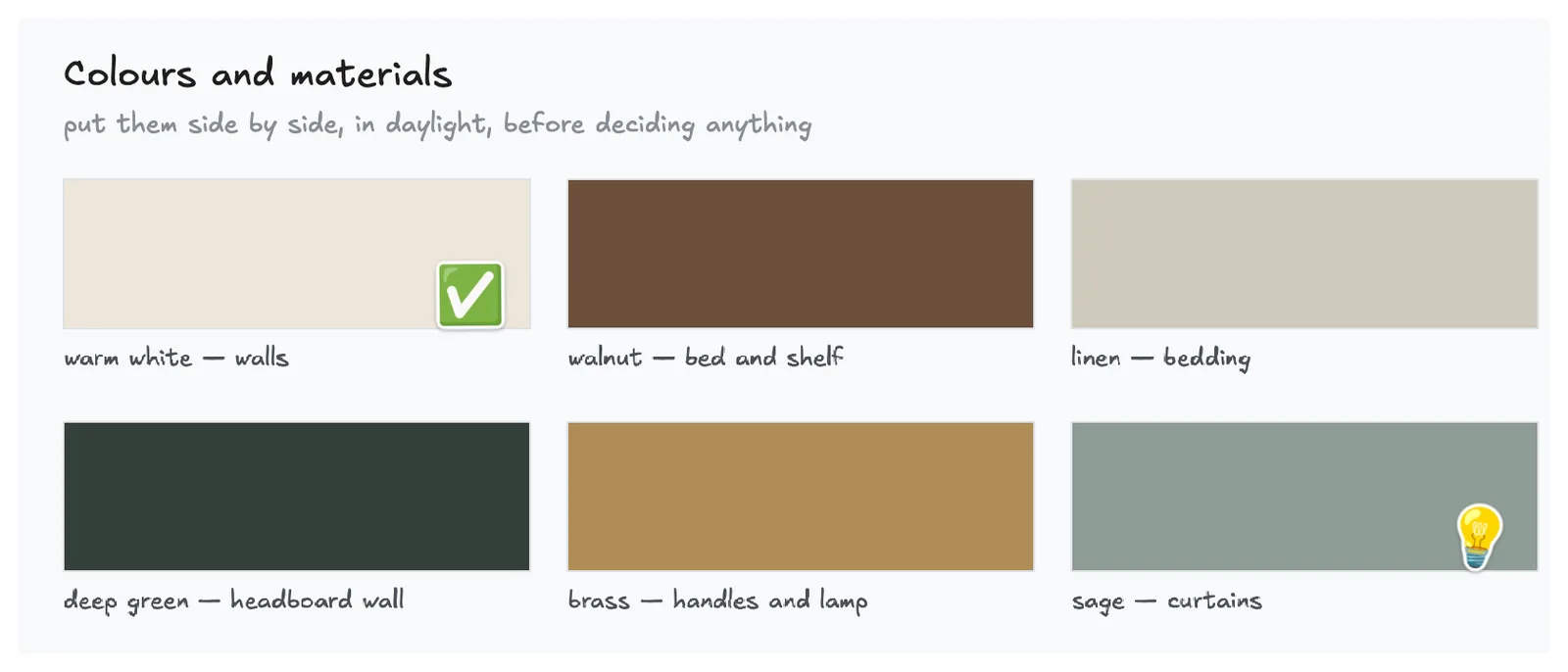
This is the part people skip and it is the part that does the work. Draw the room, put the lengths on it, and block in the furniture at roughly the right proportions.
Use the fattest stroke the app has — pick the rectangle with 2 and set
Stroke width to the third option. A plan drawn thick cannot pretend to be
accurate, which is exactly what you want: it settles what goes on which wall and refuses to have
an opinion about anything else. A tidy plan invites you to trust dimensions you never measured.
The blue line is the window with the radiator under it, and it is the single most expensive fact on the board. It removes an entire wall from consideration, which means it removes about half of the inspiration wall too — and it is much cheaper to discover that here than after a bed frame has been delivered.
The notes the photographs cannot tell you
Three sticky notes, and every one of them is a constraint that no amount of looking at other people's bedrooms would reveal: the radiator under the window, a ceiling light that is off-centre by twenty centimetres, wardrobe doors that need sixty centimetres to open.
Write these the day you notice them, not the day you need them. The ceiling light is the classic one — you will remember it exists and forget that it is off-centre, and then the bed ends up aligned to the light instead of the wall, which looks wrong forever without anyone being able to say why.
Stamps say what state each thing is in
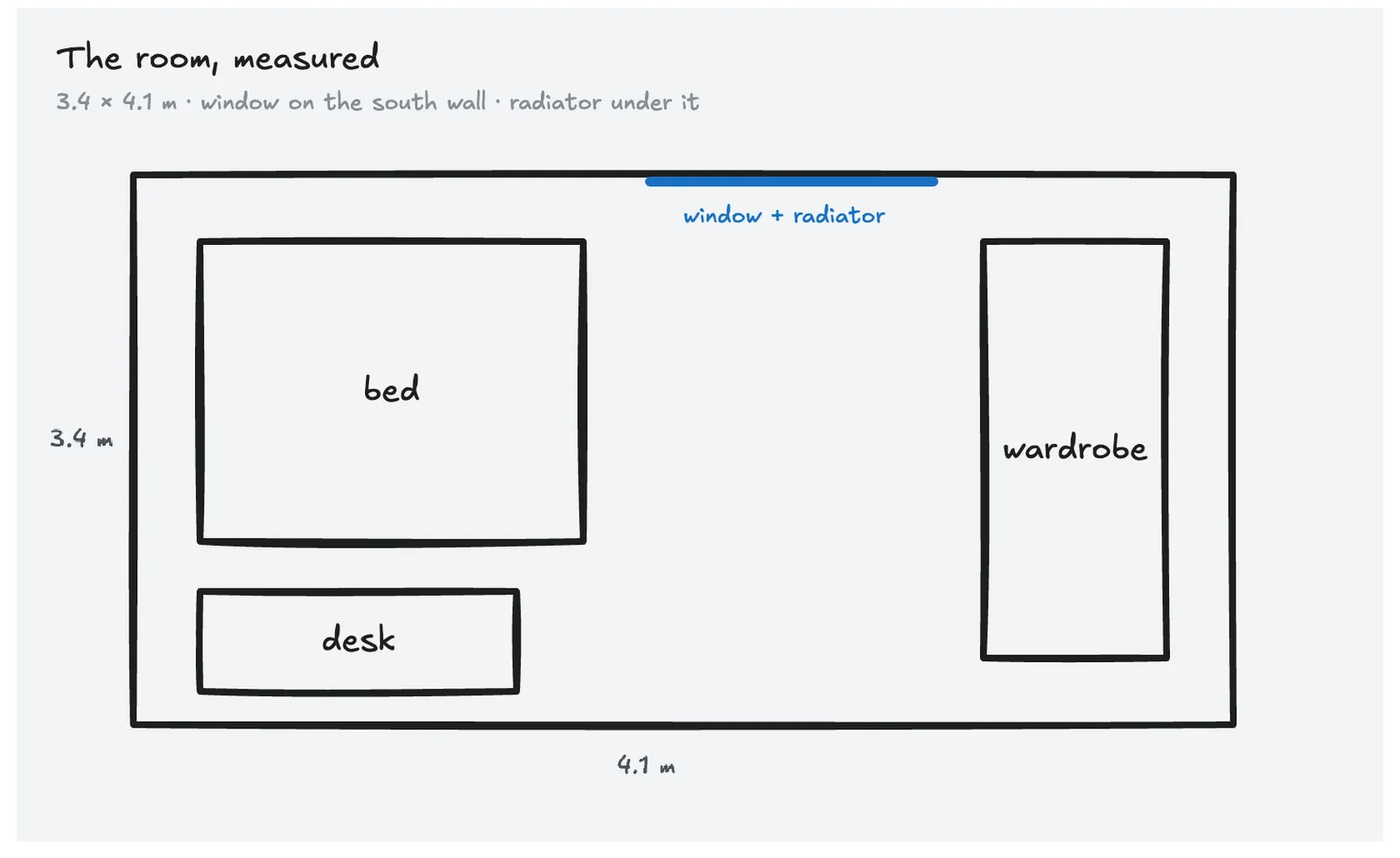
The hardest thing to keep track of in a slow project is not the ideas, it is which ideas are still live. Four stamps, agreed up front and written on the board:
- Star — decided, we are doing this.
- Light bulb — an idea for later, deliberately not now.
- Warning — check this before anyone buys it.
- Tick — bought and on its way.
The light bulb is the one worth having. Without a way to say "good idea, not this year", a good idea has only two fates: it gets done, or it gets argued out of existence and quietly resented. A stamp gives it a third — it stays on the board, visibly parked, and nobody has to keep re-litigating it. That is why the sage curtains have one on them and are not in the shopping list.
The warning stamp is the opposite: it is a hold. Anything carrying one is not to be bought until somebody has measured it, and because the stamp is on the thing itself rather than in a message, the person about to order at 11pm can see it.
What to buy, in the order it has to arrive
A checklist at the end, with K. Order matters more than completeness: paint before
the bed goes in, curtain rail before the curtains, and a mattress that cannot be delivered until
there is a frame to put it on.
The two ticked items at the top are not purchases at all — measuring the room and deciding the wall colour. Putting them on the same list as the furniture is deliberate. They are the two things that have to happen before any money is spent, and a list that starts at "bed frame" invites you to start at "bed frame".
Doing it yourself
- Paste in the pictures. Then cut them down to four and put a star on one.
- Draw the swatches as filled rectangles, in a row, labelled with what each is for.
- Draw the room at its real proportions with the thickest stroke, and write the lengths on it.
- Write a note for every constraint the moment you notice it.
- Agree what four stamps mean, put the legend on the board, and stamp things as they change state.
- Keep the shopping list as a checklist, in the order things have to arrive.
Photographs
The pictures on the inspiration wall are from Unsplash, by Clay Banks, Andreas Haslinger, Thanos Pal and Erika Mendes. The room and its measurements are invented.